Two industries, one ladder, and a record of everything you do along the way.
No idea where to start — that's the normal way to arrive here. You'll leave with credentials recognized statewide and a job with an employer we know by name.
What you're missing isn't skill. It's the paperwork, the certification, or the next step. We take the experience you already have and make it count where it matters.
Reentry, recovery, a career that ended, a country you just got to. We care whether you show up and whether you can be taught. Everything else is logistics.
Your MOS may already count toward the license. And if the military made you an instructor, we want you on the other side of the room.
A certificate is a step, not a career. Here's the whole climb, so you can see where the first one actually leads.
OSHA 10, CPR and First Aid, NCCER Core — or the hospitality equivalent, Food Handler and RBS. Job readiness, tools, and the worker-rights module nobody else teaches. You finish employable. Rung one starts before you get here — your OSHA 10 can be earned live online on a weekend, and it counts toward the same record as everything that follows.
Your trade in depth. NCCER levels, OSHA 30, ServSafe Manager, equipment certifications. This is where you stop being help and start being a hand.
Electrical and low-voltage into energy and mission-critical work. Line cook into banquet, bar, and kitchen management. Real premiums for real credentials.
Foreman readiness. Shift lead and supervisor. Reading a schedule, running a crew, holding a budget, and being the person who catches the mistake before it costs anybody.
The four years of documented journey-level experience California requires for a contractor's license — logged from your first day with us. And for some, the step past that: your own crew, your own business, subcontracting back to us.
That's the part that compounds. Ten years from now the record is still yours, and it still proves what you did.
This is the part everyone is anxious about and nobody is teaching. There is no version of this trade where these tools go away, so we're not going to hand you a lecture about them — we're going to put them in your hands on real work, the same way we hand you a meter or a knife.
Not a separate class. Not a certificate with a robot on it. Built into every track, next to the traditional skill it belongs to, because that's how it shows up on the job.
Run a takeoff and check the quantities. Look up a code section or a spec and find the clause that matters. Draft a submittal, an RFI, a daily report, a punch list. Capture and log field photos. Work through an equipment fault. Read a schedule and spot what's optimistic.
Build a prep list against a forecast. Cost a menu. Run par levels and ordering. Check an allergen or a food-safety requirement. Draft a schedule that respects everyone's availability and still covers a Friday night.
A takeoff that's four percent light. A schedule nobody can hold. A spec clause that doesn't exist. Anyone can generate an answer now — the value has moved to the person who knows when it's wrong. That's a judgment we can teach in a shop with real drawings and real consequences.
Reading a lease. Understanding a deduction on your pay stub. Prepping for a licensing exam. Getting a letter written that you need to get written. Translating something for a family member. These tools are the closest thing to free professional help that has ever existed, and knowing how to use them — and when not to trust them — is worth as much as the trade.
Get to know it. Start using it. Or get behind.
Nobody in this industry is going to say it more gently than that, so we won't either. What we will do is make sure you're on the right side of it before it costs you a job.
It can't crawl the attic, it can't take the liability, and it can't stand in front of an inspector. The license, the sign-off, and the responsibility stay with a person — and the person who can direct the tool and catch its mistakes is worth more every year, not less. That's what we're training.
One more thing, for the parents reading this. We know what your kids are hearing. The honest version is that the work we train for is going to be in demand for a long time, and the people who do it are going to be using these tools whether anyone teaches them or not. We'd rather they were taught properly.
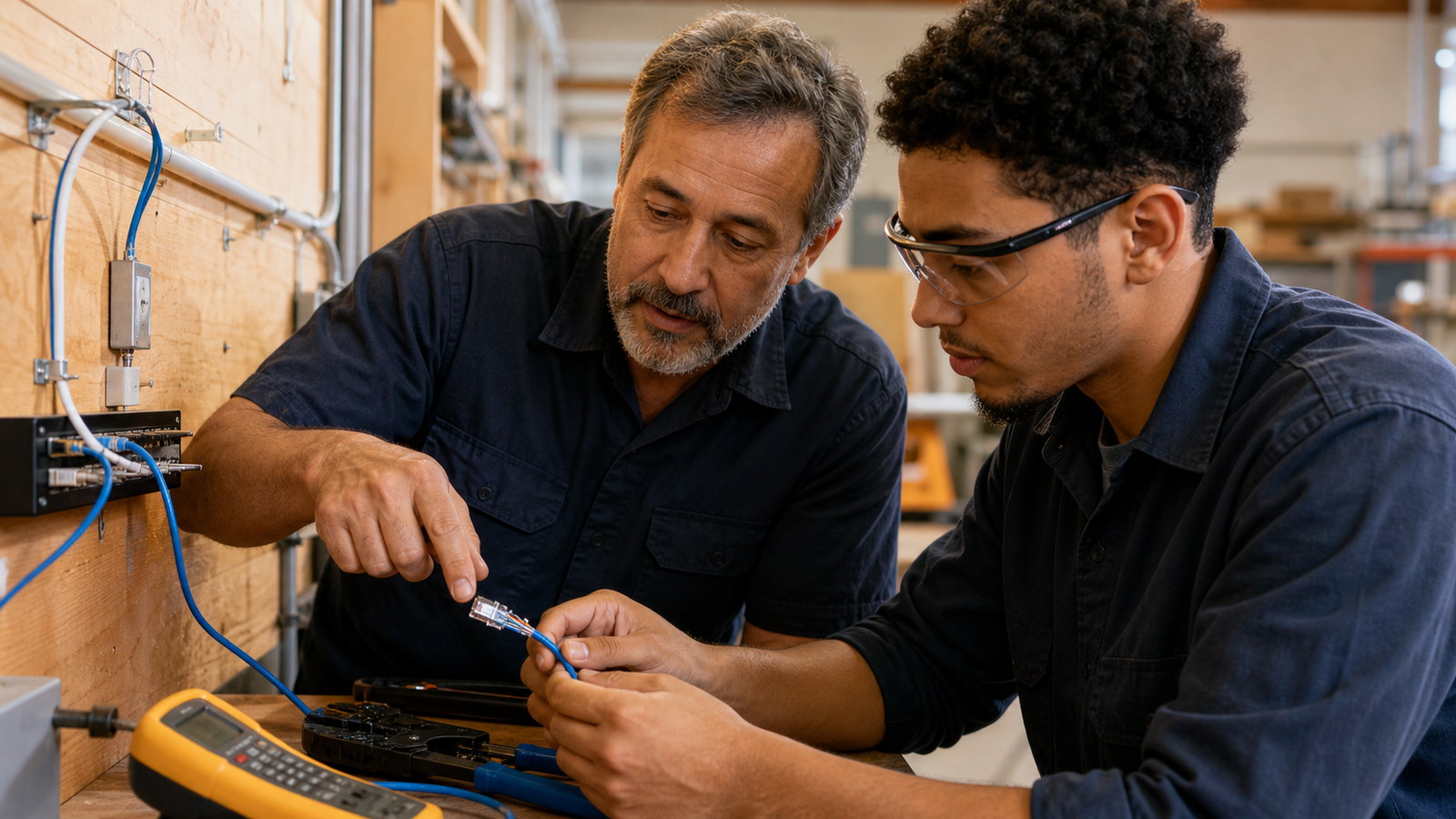
Electrical, low-voltage, plumbing, mechanical, and the commercial and industrial work Southern California cannot staff. You'll train on live jobsites with the people who run them.
And there's a piece of this that didn't exist five years ago. Every data center, every grid upgrade, every battery installation needs licensed electrical work — and the people who do it are retiring faster than they're being replaced. It's the highest-paying rung on the trade, and it starts with the same OSHA 10 card everybody else gets.
OSHA 10 and 30 · NCCER Core and craft levels · CPR and First Aid · equipment certifications · a documented hour log.
Commercial and industrial general contractors, electrical and low-voltage subcontractors, data center and mission-critical builders, utility and energy work.
Trades apprenticeships in California commonly clear $70,000. Energy and mission-critical work runs materially above standard commercial rates.
Southern California cannot staff its restaurants, hotels, and venues — and the next three years bring a run of events that will make it worse. Meanwhile the industry loses most of its people within a year, because nobody shows them a path.
We're on both sides of that. Our founders have spent decades in food and beverage, and the operators we place into are people we know by name. You get trained, you get placed properly, and you get a track that goes somewhere.
California Food Handler · RBS certification · ServSafe fundamentals and Manager · supervisor readiness.
Independent restaurants, restaurant groups, hotels, caterers, venues, and event operators across San Diego, Orange County, and the Inland Empire.
Regional demand climbs through the 2028 event cycle. Operators are hiring twelve to eighteen months ahead of it.
Not everything needs a shop. The parts that are code, law, hazard recognition and judgment teach perfectly well live on a screen — and that is where we start people.
OSHA 10 and 30. The California hospitality certifications — Food Handler, RBS, ServSafe Manager — as each one comes online. The classroom half of craft coursework as the catalog grows. Live, with a trainer on camera and a roll call — never a recording you click through alone.
Anything you learn with your hands. Welding, framing, conduit, a knife, a line during service. If someone offers to certify you in those over a webcam, walk away.
If the skill lives in your head, we can teach it anywhere. If it lives in your hands, you're coming to us.
Between workforce funding, employer-sponsored training, and — for veterans — education benefits that follow the person rather than the school, most people who come through Legacy pay little or nothing out of pocket. Some get paid while they train.
We'll walk you through what you qualify for. It's part of the intake, not a footnote.
Legacy Work Academy is not yet a VA-approved program. We are pursuing approval for on-the-job training and apprenticeship, and we will say so plainly here the moment that changes. Please don't make a decision about your benefits based on this page — talk to us and to your VA counselor first.
Tell us where you're starting from and we'll tell you what the first step looks like.
Apply